How to Tell a Real Tiffany Lamp from a Reproduction
Original Tiffany Studios lamps were made in New York between the late 1890s and the early 1930s, and authenticated examples sell at auction for thousands to millions of dollars. Most lamps described as “Tiffany” today are later Tiffany-style lamps or reproductions. This guide explains what specialists check, and where the quick checks stop being reliable.
Original, Reproduction or Tiffany-Style?
Four terms get mixed up in listings, and the difference matters:
- Original: made by Tiffany Studios, or its predecessor the Tiffany Glass and Decorating Company, under Louis Comfort Tiffany.
- Reproduction: a newer lamp that follows a specific Tiffany Studios design, such as the Dragonfly or Wisteria, as closely as practical.
- Tiffany-style: a newer lamp made with the same leaded-glass technique but with its own pattern.
- Fake: any lamp, usually a reproduction, sold with false marks or a false story to pass as an original. The lamp is not the problem; the claim is.
1. Check the Marks, but Do Not Stop There
Original leaded shades usually carry a small bronze tag or an impressed stamp reading TIFFANY STUDIOS NEW YORK on the inside of the lower rim, often with a model number. Bases are normally stamped TIFFANY STUDIOS NEW YORK on the underside, also with a model number. Some early pieces carry the monogram of the Tiffany Glass and Decorating Company.
Marks are also the easiest feature to fake. Tags can be soldered onto new shades and stamps added to new bases, so a correct-looking mark only means the lamp deserves a closer look. A lamp with no marks at all needs very strong evidence before anyone should call it original.
2. Look at the Glass, Lit and Unlit
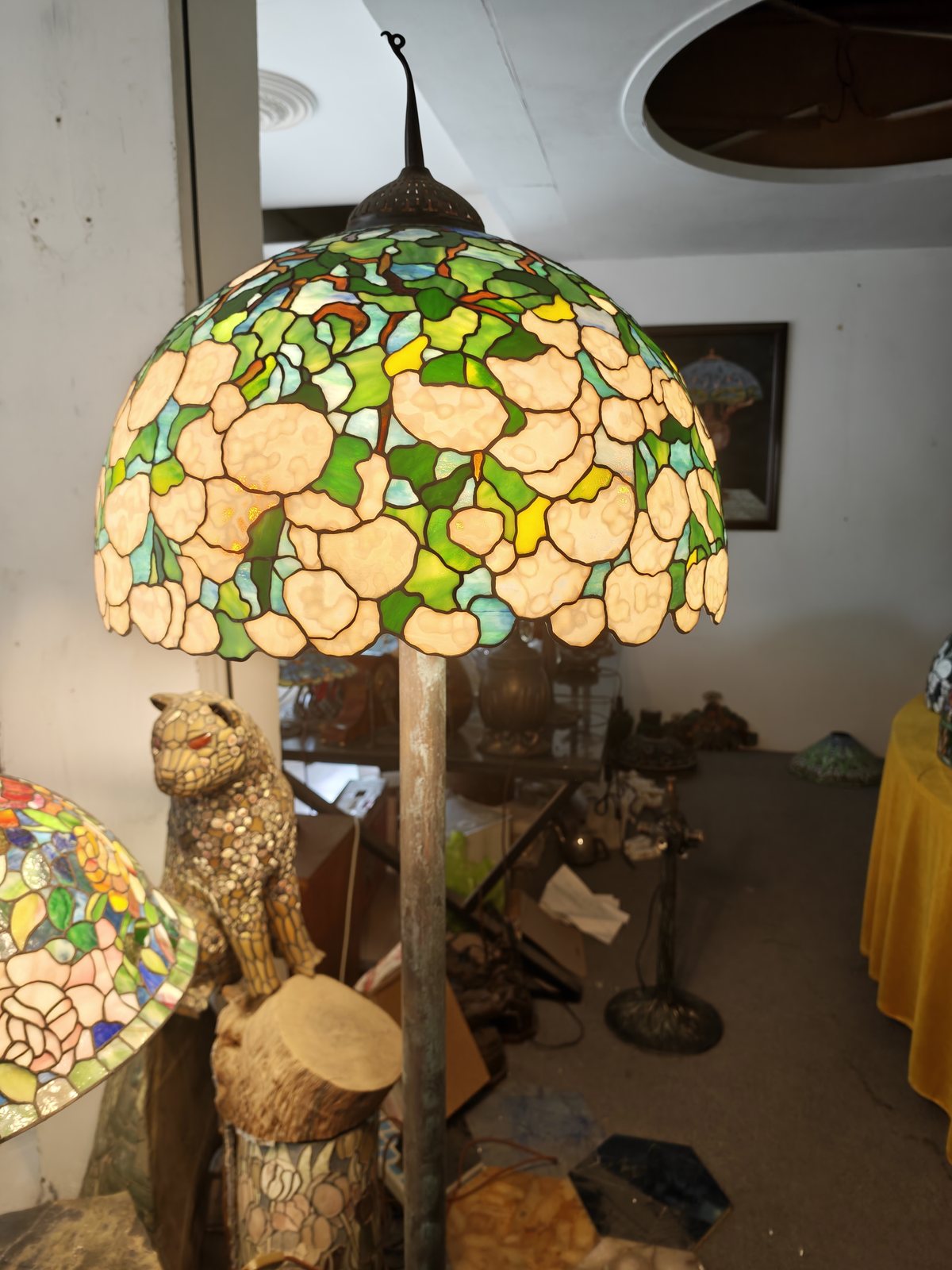
Tiffany’s own furnaces in Corona, Queens made glass whose colour and texture change within a single sheet: streaky, mottled and fractured “confetti” glass, and rippled or folded “drapery” glass. In a good original, one leaf can move from yellow to deep green, and the shade looks very different lit and unlit.
Many low-cost reproductions use flat, even sheet glass, so each piece reads as a single colour. Better reproductions choose varied glass too, so rich glass alone does not prove age. Flat, uniform colour across the whole shade does point to modern, budget production.
3. Weigh and Inspect the Base
Original bases were cast in bronze and finished with a hand-applied patina. They are heavy for their size, and wear shows naturally on raised edges where hands have touched them for a century. Many reproductions use zinc alloy, resin or plated metal, which feel lighter in the hand.
A magnet will not stick to bronze, but it will not stick to zinc either, so the magnet test only rules out steel or iron bases. It cannot confirm bronze.
4. Study the Construction and Wiring
Tiffany Studios built its leaded shades with copper foil, and the solder lines vary in width as they follow the design. Very uniform, heavy lines and perfectly regular pieces can suggest later production. Look at how the shade sits on the base, and whether the hardware, heat cap and finial look like they belong together.
Wiring is less helpful than people expect. Most originals have been rewired at least once, so a new cord does not mean a lamp is new. A fully modern switch, socket and cord built into a base with no trace of earlier fittings does point to newer manufacture.
5. Compare the Price and Ask for Provenance
Authentic leaded Tiffany Studios lamps are expensive even in modest condition. If a “real Tiffany” is offered for a few hundred dollars, it is almost certainly a reproduction or a Tiffany-style lamp. For any lamp sold as original, ask for its ownership history and auction records, and get a written opinion from a recognised specialist or auction house before you pay.
Quick Checklist
- Marks present, in the right places, and consistent with the model number
- Glass with colour and texture changing inside individual pieces
- A heavy cast bronze base with natural wear on high points
- Construction and hardware consistent with the lamp’s age
- A price and provenance that make sense for an original
- A specialist’s written opinion for anything sold as authentic
Buying Reproductions the Honest Way
A well-made reproduction is a legitimate decorative lamp, and for most homes, shops and hotels it is the sensible choice. What matters is the description. We make reproductions of classic Tiffany Studios designs and sell them as reproductions, under our own name, without Tiffany Studios marks.
To see how they are built, read how Tiffany lamps are made, or learn more about the original studio in the story behind Tiffany Studios.